कक्षा 12वीं वार्षिक परीक्षा पेपर एमपी बोर्ड भौतिक शास्त्र या भौतिक विज्ञान का पेपर 13 फरवरी 2026 को 12:00 बजे सफलतापूर्वक पूर्णता रूप से हो चुका है यह पेपर 75 अंकों का आया
mp board 12th physics varshik pariksha paper 2026 set a
आज जो कक्षा 12वीं वार्षिक परीक्षा पेपर एमपी बोर्ड भौतिक शास्त्र या भौतिक विज्ञान का पेपर 13 फरवरी 2026 को 12:00 बजे सफलतापूर्वक पूर्णता रूप से हो चुका है यह पेपर 75 अंकों का आया चलिए इस पेपर में जो ऑब्जेक्टिव टाइप क्वेश्चन और इसमें एक अंक से लेकर जितने भी प्रश्न पूछे गए हैं उनका सॉल्यूशन आपको बताते हैं जैसे कि आप सही आंसर को मिल सके. जिन छात्रों का mp board 12th physics varshik pariksha paper 2026 set a पेपर आया है इसका सॉल्यूशन और उसकी पीडीएफ के साथ नीचे दी गई है जिससे कि आप सही उत्तर का मिलान कर सकें.
MP Board Paper Send & Answer Dekho
Academic for Students
Click to select or drag and drop paper image
Document Selected
Analysing Document…
आपकी फाइल शिक्षक के पास भेजी जा रही है, कृपया प्रतीक्षा करें।
✓
सफलतापूर्वक भेजी गई!
शिक्षक द्वारा इस पेपर का समाधान तैयार किया जा रहा है। इसे जल्द ही मुख्य पोस्ट पर अपडेट कर दिया जाएगा।
mp board 12th physics varshik pariksha paper 2026 set b
आज जो कक्षा 12वीं वार्षिक परीक्षा पेपर एमपी बोर्ड भौतिक शास्त्र या भौतिक विज्ञान का पेपर 13 फरवरी 2026 को 12:00 बजे सफलतापूर्वक पूर्णता रूप से हो चुका है यह पेपर 75 अंकों का आया चलिए इस पेपर में जो ऑब्जेक्टिव टाइप क्वेश्चन और इसमें एक अंक से लेकर जितने भी प्रश्न पूछे गए हैं उनका सॉल्यूशन आपको बताते हैं जैसे कि आप सही आंसर को मिल सके. जिन छात्रों का mp board 12th physics varshik pariksha paper 2026 set b पेपर आया है इसका सॉल्यूशन और उसकी पीडीएफ के साथ नीचे दी गई है जिससे कि आप सही उत्तर का मिलान कर सकें.
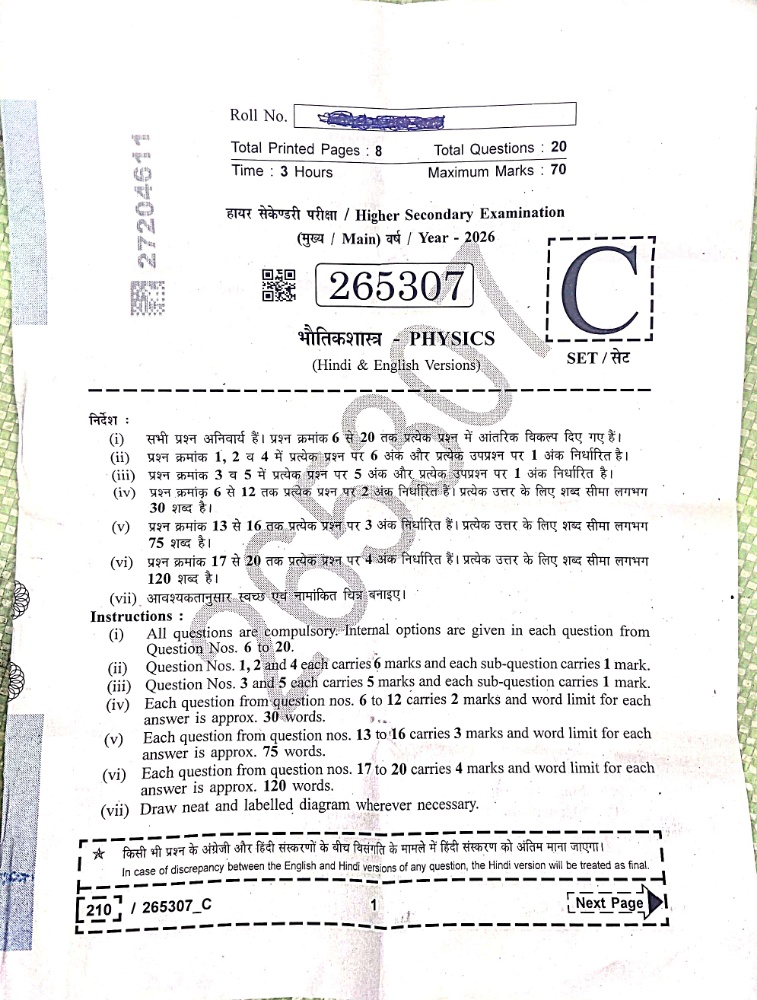
mp board 12th physics varshik pariksha paper 2026 set c
आज जो कक्षा 12वीं वार्षिक परीक्षा पेपर एमपी बोर्ड भौतिक शास्त्र या भौतिक विज्ञान का पेपर 13 फरवरी 2026 को 12:00 बजे सफलतापूर्वक पूर्णता रूप से हो चुका है यह पेपर 75 अंकों का आया चलिए इस पेपर में जो ऑब्जेक्टिव टाइप क्वेश्चन और इसमें एक अंक से लेकर जितने भी प्रश्न पूछे गए हैं उनका सॉल्यूशन आपको बताते हैं जैसे कि आप सही आंसर को मिल सके. जिन छात्रों का mp board 12th physics varshik pariksha paper 2026 set c पेपर आया है इसका सॉल्यूशन और उसकी पीडीएफ के साथ नीचे दी गई है जिससे कि आप सही उत्तर का मिलान कर सकें.
MP Board 12th Physics Set C (265307) – Full Paper
Roll No.
Total Printed Pages : 8
Total Questions : 20
Time : 3 Hours
Maximum Marks : 70
हायर सेकेण्डरी परीक्षा / Higher Secondary Examination(मुख्य / Main) वर्ष / Year – 2026
265307
C
SET / सेट
भौतिकशास्त्र – PHYSICS(Hindi & English Versions)
निर्देश :
(i)
सभी प्रश्न अनिवार्य हैं। प्रश्न क्रमांक 6 से 20 तक प्रत्येक प्रश्न में आंतरिक विकल्प दिए गए हैं।
(ii)
प्रश्न क्रमांक 1, 2 व 4 में प्रत्येक प्रश्न पर 6 अंक और प्रत्येक उपप्रश्न पर 1 अंक निर्धारित है।
(iii)
प्रश्न क्रमांक 3 व 5 में प्रत्येक प्रश्न पर 5 अंक और प्रत्येक उपप्रश्न पर 1 अंक निर्धारित है।
(iv)
प्रश्न क्रमांक 6 से 12 तक प्रत्येक प्रश्न पर 2 अंक निर्धारित हैं। प्रत्येक उत्तर के लिए शब्द सीमा लगभग 30 शब्द है।
(v)
प्रश्न क्रमांक 13 से 16 तक प्रत्येक प्रश्न पर 3 अंक निर्धारित हैं। प्रत्येक उत्तर के लिए शब्द सीमा लगभग 75 शब्द है।
(vi)
प्रश्न क्रमांक 17 से 20 तक प्रत्येक प्रश्न पर 4 अंक निर्धारित हैं। प्रत्येक उत्तर के लिए शब्द सीमा लगभग 120 शब्द है।
(vii)
आवश्यकतानुसार स्वच्छ एवं नामांकित चित्र बनाइए।
Instructions :
(i)
All questions are compulsory. Internal options are given in each question from Question Nos. 6 to 20.
(ii)
Question Nos. 1, 2 and 4 each carries 6 marks and each sub-question carries 1 mark.
(iii)
Question Nos. 3 and 5 each carries 5 marks and each sub-question carries 1 mark.
(iv)
Each question from question nos. 6 to 12 carries 2 marks and word limit for each answer is approx. 30 words.
(v)
Each question from question nos. 13 to 16 carries 3 marks and word limit for each answer is approx. 75 words.
(vi)
Each question from question nos. 17 to 20 carries 4 marks and word limit for each answer is approx. 120 words.
(vii)
Draw neat and labelled diagram wherever necessary.
1
उचित शब्द के द्वारा रिक्त स्थानों की पूर्ति कर लिखिये :
(a)
चुम्बकीय फ्लक्स घनत्व ______________ राशि है।
(b)
जल शोधक में ______________ किरणों के लैम्पों का उपयोग जीवाणुओं को मारने में होता है।
(c)
एक अध्रुवित तरंग के लिये विस्थापन, समय के साथ, यादृच्छिकतः बदलता रहता है, यद्यपि यह सदैव तरंग संचरण की दिशा के ______________ रहता है।
(d)
फोटॉन का विराम द्रव्यमान ______________ होता है।
(e)
प्लांक नियतांक का मान ______________ होता है।
(f)
जरमेनियम डायोड के लिये देहली वोल्टता लगभग ______________ वोल्ट होती है।
Fill in the blanks with appropriate word and write:
(a)
Magnetic flux density is ______________ quantity.
(b)
The lamps of ______________ rays are used to kill germs in water purifiers.
(c)
For an unpolarized wave the displacement will be randomly changing with time though it will always be ______________ to the direction of propagation.
(d)
The rest mass of photon is ______________.
(e)
The value of Planck’s constant is ______________.
(f)
For germanium diode threshold voltage is nearly ______________ volt.
1×6=6
2
स्तंभ ‘अ’ को स्तंभ ‘ब’ से मिलाकर सही जोड़ी लिखिये :
स्तंभ ‘अ’
स्तंभ ‘ब’
(a)
विद्युत फ्लक्स
(i)
μ0nI
(b)
विभव प्रवणता
(ii)
वोल्ट × सेकण्ड
(c)
चुम्बकीय फ्लक्स
(iii)
μ0nI / 2
(d)
गतिक वि.वा.ब.
(iv)
वोल्ट × मीटर
(e)
परिनालिका के अंदर चुम्बकीय क्षेत्र
(v)
वोल्ट × मीटर-1
(f)
परिनालिका के किसी एक सिरे पर चुम्बकीय क्षेत्र
(vi)
वोल्ट
Match the Column ‘A’ with Column ‘B’ and write the correct pair :
Column ‘A’
Column ‘B’
(a)
Electric flux
(i)
μ0nI
(b)
Potential gradient
(ii)
Volt × second
(c)
Magnetic flux
(iii)
μ0nI / 2
(d)
Motional emf
(iv)
Volt × meter
(e)
Magnetic field inside solenoid
(v)
Volt × meter-1
(f)
Magnetic field at any end of solenoid
(vi)
Volt
1×6=6
3
प्रत्येक प्रश्न का एक वाक्य में उत्तर दीजिये –
(a)
धारा घनत्व, विशिष्ट चालकता तथा विद्युत क्षेत्र की तीव्रता के पदों में ओम का नियम लिखिये।
(b)
चुम्बकशीलता का विमीय सूत्र लिखिये।
(c)
LCR परिपथ की प्रतिबाधा का सूत्र लिखिये।
(d)
प्रकाश के अपवर्तन की घटना में उसका कौन-सा गुण अपरिवर्तित रहता है?
(e)
P-प्रकार के अर्द्धचालक में बहुसंख्यक आवेश वाहक कौन होते हैं?
Write answer of each question in one sentence :
(a)
State Ohm’s law in terms of current density, specific conductance and electric field intensity.
(b)
Write dimensional formula of magnetic permeability.
(c)
Write the formula of impedance of LCR circuit.
(d)
In phenomenon of refraction of light, which property of it remain unchanged?
(e)
Who are the majority charge carrier in P-type semiconductor?
1×5=5
4
प्रत्येक प्रश्न में दिये गये विकल्पों में से सही विकल्प चुनकर लिखिये :
(a)
आदर्श विद्युत द्विध्रुव का आकार होता है –
(i) शून्य(ii) अनन्त(iii) एक(iv) उपरोक्त में से कोई नहीं
(b)
पृथ्वी का मानक विभव है –
(i) शून्य(ii) अनन्त(iii) एक(iv) उपरोक्त में से कोई नहीं
(c)
अवरक्त तरंगों की तरंगदैर्घ्य परास है –
(i) 400 nm से 700 nm तक(ii) 1 nm से 400 nm तक(iii) 1 mm से 0.1 m तक(iv) 700 nm से 1 mm तक
(d)
यदि आपतन कोण का मान किसी तल के लिये 60° है, तब उस तल पर परावर्तन कोण होगा –
In P-n junction diode the width of depletion layer is :
(i) 1 m(ii) 1 μm(iii) 1 nm(iv) 1 pm
1×6=6
5
सत्य अथवा असत्य लिखिये :
(a)
गुणता कारक ωrLR है।
(b)
विवर्तन की घटना में ऊर्जा का पुनर्वितरण होता है।
(c)
उपयुक्त तापन के द्वारा मुक्त इलेक्ट्रॉनों को पर्याप्त तापीय ऊर्जा दी जा सकती है जिससे कि वे धातु से बाहर आ सके।
(d)
γ-क्षय में निम्न ऊर्जा के फोटॉन उत्सर्जित होते हैं।
(e)
अर्द्धचालकों का ताप बढ़ाने से, उनकी चालकता कम हो जाती है।
Write True or False :
(a)
The quality factor is ωrLR.
(b)
The energy redistribution takes place in phenomenon of diffraction.
(c)
By suitably heating, sufficient thermal energy can be imparted to the free electrons to enable them to come out of the metal.
(d)
In γ-decay low enegy photons are emitted.
(e)
On increasing the temperature of semiconductors, their conductance becomes less.
1×5=5
6
बोर मॉडल का उपयोग करके किसी हाइड्रोजन परमाणु में n = 1 तथा 2 स्तरों पर इलेक्ट्रॉन की ऊर्जा परिकलित कीजिये।
Using the Bohr’s model, calculate the energy of the electron in a hydrogen atom for n = 1 and 2 levels.
अथवा / OR
1 ग्राम पदार्थ के समतुल्य ऊर्जा को परिकलित कीजिये।
Calculate the energy equivalent of 1 g of substance.
2
7
दिखाइये कि विद्युत क्षेत्र के किसी समान्तर पृष्ठ से गुजरने वाला विद्युत फ्लक्स का मान शून्य होता है।
Show that the electric flux passing through a surface parallel to electric field is zero.
अथवा / OR
आयतन आवेश घनत्व क्या है? इसका S.I. मात्रक लिखिये।
What is volume charge density? Write its S.I. unit.
2
8
ओमीय तथा अनओमीय प्रतिरोध क्या हैं?
What are ohmic and non-ohmic resistances?
अथवा / OR
आन्तरिक प्रतिरोध क्या है? इसका विमीय सूत्र लिखिये।
What is internal resistance? Write its dimensional formula.
2
9
ऐम्पियर का परिपथीय नियम लिखिये।
State Ampere’s circuital law.
अथवा / OR
प्रतिचुम्बकीय तथा अनुचुम्बकीय पदार्थों में दो अन्तर लिखिये।
Write two difference between diamagnetic and paramagnetic substances.
2
10
विद्युत चुम्बकीय तरंगों के दो गुण लिखिये।
Write two properties of electromagnetic waves.
अथवा / OR
घटती आवृत्ति के क्रम में विभिन्न विद्युत चुम्बकीय तरंगों के नाम लिखिये।
Write the names of different electromagnetic waves in decreasing order of their frequencies.
2
11
एक लेंस की क्षमता −5D है। इसकी फोकस दूरी ज्ञात करो। लेंस का नाम क्या है?
The power of lens is −5D. Find its focal length. What is the name of lens?
अथवा / OR
किसी छोटी दूरबीन के अभिदृश्यक की फोकस दूरी 144 cm तथा नेत्रिका की फोकस दूरी 6.0 cm है। दूरबीन की आवर्धन क्षमता कितनी है? अभिदृश्यक तथा नेत्रिका के बीच पृथकन दूरी क्या है?
A small telescope has an objective lens of focal length 144 cm and an eyepiece of focal length 6.0 cm. What is the magnifying power of telescope? What is the separation between the objective and the eyepiece?
1+1=2
12
दे ब्रॉग्ली तरंग क्या है? गतिमान कण के लिये इसका सूत्र लिखिये।
What is de-Broglie wave? Write formula of it for moving particle.
अथवा / OR
आइन्सटीन का प्रकाश विद्युत समीकरण लिखिये।
Write Einstein’s photoelectric equation.
1+1=2
13
N-प्रकार तथा P-प्रकार के अर्द्धचालकों में कोई तीन अंतर लिखिये।
State three difference between N-type and P-type semiconductors.
अथवा / OR
P-N संधि डायोड का अर्द्धतरंग दिष्टकारी के रूप में उपयोग का वर्णन निम्न शीर्षकों के अंतर्गत कीजिये :
(i) सिद्धान्त (ii) विद्युत परिपथ (iii) कार्यविधि
Explain use of P-N junction diode as a half wave rectifier under the following heads :
(i) Principle (ii) Electric circuit (iii) Working
3
14
अनुगमन वेग क्या है? धारा घनत्व तथा अनुगमन वेग में सम्बन्ध स्थापित कीजिये।
What is drift velocity? Establish relationship between current density and drift velocity.
अथवा / OR
सेल के आंतरिक प्रतिरोध, वि.वा. बल तथा टर्मिनल वोल्टेज में सम्बन्ध स्थापित कीजिये।
Establish relationship between internal resistance, emf and terminal voltage of cell.
1+2=3
15
चल कुण्डली धारामापी की सुग्राहिता को परिभाषित कीजिए। उसका सूत्र लिखिए एवं इसका मान अधिकतम होने की शर्ते लिखिए।
Define the sensitivity of moving coil galvanometer. Write its formula and write conditions for maximum value of it.
अथवा / OR
बायो-सावार्ट का नियम समझाइये।
Explain Biot-Savart’s law.
3
16
बोर के परमाणु मॉडल के तीन अभिगृहीत लिखिये।
State three postulates of Bohr’s atomic model.
अथवा / OR
नाभिकीय बल क्या है? इनके कोई दो गुण लिखिए।
What is nuclear force? Write any two properties of it.
3
17
(i)
क्रांतिक कोण क्या है? माध्यम के अपवर्तनांक तथा क्रांतिक कोण में सम्बन्ध स्थापित कीजिये।
(ii)
पूर्ण आंतरिक परावर्तन की शर्ते लिखिये।
(i)
What is critical angle? Establish relationship between critical angle and refractive index of medium.
(ii)
State conditions of total internal reflection.
अथवा / OR
(i)
जब एकवर्णीय प्रकाश दो माध्यमों को पृथक करने वाली सतह पर आपतित होता है, तब परावर्तित एवं अपवर्तित दोनों प्रकाश की आवृत्तियाँ समान होती हैं। स्पष्ट कीजिये क्यों?
(ii)
जब प्रकाश विरल से सघन माध्यम में गति करता है तो उसकी चाल में कमी आती हैं। क्या चाल में आई कमी प्रकाश तरंगों द्वारा संचारित ऊर्जा की कमी को दर्शाती है?
(iii)
प्रकाश की तरंग अवधारणा में, प्रकाश की तीव्रता का आंकलन तरंग के आयाम के वर्ग से किया जाता है। वह क्या है जो प्रकाश की फोटॉन अवधारणा में प्रकाश की तीव्रता का निर्धारण करता है?
(i)
When monochromatic light is incident on a surface separating two media, the reflected and refracted light both have the same frequency as the incident frequency. Explain why?
(ii)
When light travels from a rarer to denser medium, the speed decreases. Does the reduction in speed imply a reduction in the energy carried by the light wave?
(iii)
In the wave picture of light, intensity of light is determined by the square of the amplitude of the wave. What determines intensity of light in the photon picture of light?
1+2+1=4
18
उत्तल पृष्ठ से अपवर्तन का सूत्र nv − 1u = n − 1R निगमित कीजिये।
Derive formula nv − 1u = n − 1R of refraction from convex surface.
अथवा / OR
संपर्क में रखे पतले लेंसों की फोकस दूरी का व्यंजक निगमित कीजिये।
Derive an expression for focal length of thin lenses kept in contact.
4
19
बिन्दु आवेश के कारण उसके निकट स्थित बिन्दु पर विद्युत विभव के लिए व्यंजक निगमित कीजिए।
Derive an expression for electric potential at a point situated near the point due to a point charge.
अथवा / OR
संधारित्रों के श्रेणी संयोजन तथा समान्तर संयोजन में तुल्य धारिताओं के व्यंजक निगमित कीजिये।
Derive expressions for equivalent capacitances in series combination and parallel combination of capacitors.
4
20
ट्रांसफॉर्मर में होने वाली विभिन्न ऊर्जा हानियाँ समझाइये।
Explain different energy losses in transformer.
अथवा / OR
फैराडे के विद्युत-चुम्बकीय प्रेरण के नियम लिखिये एवं द्वितीय नियम की व्याख्या कीजिये।
State Faraday’s laws of electromagnetic induction and explain second law.
4
✪
किसी भी प्रश्न के अंग्रेजी और हिंदी संस्करणों के बीच विसंगति के मामले में हिंदी संस्करण को अंतिम माना जाएगा। In case of discrepancy between the English and Hindi versions of any question, the Hindi version will be treated as final.
MP Board 12th Physics Set C (265307) – Solved Full Paper
Roll No.
Total Printed Pages : 8
Total Questions : 20
Time : 3 Hours
Maximum Marks : 70
हायर सेकेण्डरी परीक्षा / Higher Secondary Examination(मुख्य / Main) वर्ष / Year – 2026
265307
C
SET / सेट
भौतिकशास्त्र – PHYSICS(Hindi & English Versions)
निर्देश :
(i)
सभी प्रश्न अनिवार्य हैं। प्रश्न क्रमांक 6 से 20 तक प्रत्येक प्रश्न में आंतरिक विकल्प दिए गए हैं।
(ii)
प्रश्न क्रमांक 1, 2 व 4 में प्रत्येक प्रश्न पर 6 अंक और प्रत्येक उपप्रश्न पर 1 अंक निर्धारित है।
(iii)
प्रश्न क्रमांक 3 व 5 में प्रत्येक प्रश्न पर 5 अंक और प्रत्येक उपप्रश्न पर 1 अंक निर्धारित है।
(iv)
प्रश्न क्रमांक 6 से 12 तक प्रत्येक प्रश्न पर 2 अंक निर्धारित हैं। प्रत्येक उत्तर के लिए शब्द सीमा लगभग 30 शब्द है।
(v)
प्रश्न क्रमांक 13 से 16 तक प्रत्येक प्रश्न पर 3 अंक निर्धारित हैं। प्रत्येक उत्तर के लिए शब्द सीमा लगभग 75 शब्द है।
(vi)
प्रश्न क्रमांक 17 से 20 तक प्रत्येक प्रश्न पर 4 अंक निर्धारित हैं। प्रत्येक उत्तर के लिए शब्द सीमा लगभग 120 शब्द है।
(vii)
आवश्यकतानुसार स्वच्छ एवं नामांकित चित्र बनाइए।
1
उचित शब्द के द्वारा रिक्त स्थानों की पूर्ति कर लिखिये / Fill in the blanks :
(a)
चुम्बकीय फ्लक्स घनत्व ______________ राशि है। (Magnetic flux density is ______________ quantity.)
Answerसदिश / Vector
(b)
जल शोधक में ______________ किरणों के लैम्पों का उपयोग जीवाणुओं को मारने में होता है। (The lamps of ______________ rays are used to kill germs in water purifiers.)
Answerपराबैंगनी / Ultraviolet (UV)
(c)
एक अध्रुवित तरंग के लिये विस्थापन, समय के साथ, यादृच्छिकतः बदलता रहता है, यद्यपि यह सदैव तरंग संचरण की दिशा के ______________ रहता है। (For an unpolarized wave the displacement will be randomly changing with time though it will always be ______________ to the direction of propagation.)
Answerलम्बवत् / Perpendicular
(d)
फोटॉन का विराम द्रव्यमान ______________ होता है। (The rest mass of photon is ______________.)
Answerशून्य / Zero
(e)
प्लांक नियतांक का मान ______________ होता है। (The value of Planck’s constant is ______________.)
Answer6.626 × 10-34 J·s
(f)
जरमेनियम डायोड के लिये देहली वोल्टता लगभग ______________ वोल्ट होती है। (For germanium diode threshold voltage is nearly ______________ volt.)
Answer0.3 V
1×6=6
2
स्तंभ ‘अ’ को स्तंभ ‘ब’ से मिलाकर सही जोड़ी लिखिये / Match the Column :
Column ‘A’
Column ‘B’
(a)
Electric flux (विद्युत फ्लक्स)
(i)
μ0nI
(b)
Potential gradient (विभव प्रवणता)
(ii)
Volt × second
(c)
Magnetic flux (चुम्बकीय फ्लक्स)
(iii)
μ0nI / 2
(d)
Motional emf (गतिक वि.वा.ब.)
(iv)
Volt × meter
(e)
Magnetic field inside solenoid
(v)
Volt × meter-1
(f)
Magnetic field at any end of solenoid
(vi)
Volt
Correct Matches:
(a) Electric flux → (iv) Volt × meter
(b) Potential gradient → (v) Volt × meter-1
(c) Magnetic flux → (ii) Volt × second
(d) Motional emf → (vi) Volt
(e) Magnetic field inside solenoid → (i) μ0nI
(f) Magnetic field at any end of solenoid → (iii) μ0nI / 2
1×6=6
3
प्रत्येक प्रश्न का एक वाक्य में उत्तर दीजिये / Write answer in one sentence :
(a)
State Ohm’s law in terms of current density, specific conductance and electric field intensity.
AnswerJ = σ E
(b)
Write dimensional formula of magnetic permeability.
Answer[M L T-2 A-2]
(c)
Write the formula of impedance of LCR circuit.
AnswerZ = √[R2 + (XL – XC)2]
(d)
In phenomenon of refraction of light, which property of it remain unchanged?
AnswerFrequency (आवृत्ति)
(e)
Who are the majority charge carrier in P-type semiconductor?
AnswerHoles (होल/कोटर)
1×5=5
4
सही विकल्प चुनकर लिखिये / Choose the correct option :
(a)
The size of ideal dipole is ______
(i) Zero(ii) Infinite(iii) One(iv) None of the above
Answer(i) Zero (शून्य)
(b)
The standard potential of earth is ______
(i) Zero(ii) Infinite(iii) One(iv) None of the above
Answer(i) Zero (शून्य)
(c)
The wavelength range of infra-red waves is ______
(i) 400 nm to 700 nm(ii) 1 nm to 400 nm(iii) 1 mm to 0.1 m(iv) 700 nm to 1 mm
Answer(iv) 700 nm to 1 mm
(d)
If the value of angle of incidence for a surface is 60°, then angle of reflection at that plane will be :
In P-n junction diode the width of depletion layer is :
(i) 1 m(ii) 1 μm(iii) 1 nm(iv) 1 pm
Answer(ii) 1 μm (Approx)
1×6=6
5
सत्य अथवा असत्य लिखिये / Write True or False :
(a)
The quality factor is ωrL / R.
AnswerTrue (सत्य)
(b)
The energy redistribution takes place in phenomenon of diffraction.
AnswerTrue (सत्य)
(c)
By suitably heating, sufficient thermal energy can be imparted to the free electrons to enable them to come out of the metal.
AnswerTrue (सत्य – Thermionic Emission)
(d)
In γ-decay low energy photons are emitted.
AnswerFalse (असत्य – High energy photons are emitted)
(e)
On increasing the temperature of semiconductors, their conductance becomes less.
AnswerFalse (असत्य – Conductance increases with temperature)
1×5=5
6
Using the Bohr’s model, calculate the energy of the electron in a hydrogen atom for n = 1 and 2 levels.
Answer
Formula: En = -13.6 / n2 eV
For n = 1: E1 = -13.6 eV
For n = 2: E2 = -13.6 / (2)2 = -3.4 eV
अथवा / OR
Calculate the energy equivalent of 1 g of substance.
OR Answer
Using Einstein’s formula: E = mc2
m = 1 g = 10-3 kg, and c = 3 × 10⁸ m/s
E = 10-3 × (3 × 108)2 = 9 × 10¹³ Joules
2
7
Show that the electric flux passing through a surface parallel to electric field is zero.
Answer
Electric flux Φ = E · A cos(θ).
If the surface is parallel to the electric field E, its area vector A (which is normal to the surface) is perpendicular to E.
Therefore, θ = 90°. Since cos(90°) = 0, the flux Φ = 0.
अथवा / OR
What is volume charge density? Write its S.I. unit.
OR Answer
Volume charge density (ρ) is the amount of electric charge per unit volume of a space.
Formula: ρ = q / V
Its S.I. unit is Coulomb per cubic meter (C/m3).
2
8
What are ohmic and non-ohmic resistances?
Answer
Ohmic Resistances: Conductors that strictly obey Ohm’s law (V ∝ I) at constant temperature (e.g., Copper wire). Non-ohmic Resistances: Conductors that do not obey Ohm’s law (e.g., Semiconductor diodes, vacuum tubes).
अथवा / OR
What is internal resistance? Write its dimensional formula.
OR Answer
The resistance offered by the electrolyte and electrodes of a cell to the flow of current inside it is called internal resistance (r).
Dimensional Formula: [M L2 T-3 A-2]
2
9
State Ampere’s circuital law.
Answer
Ampere’s circuital law states that the line integral of the magnetic field (B) around any closed loop in a vacuum is equal to μ0 times the total current (I) passing through the surface enclosed by the loop.
Mathematically: ∮ B · dl = μ0 I
अथवा / OR
Write two difference between diamagnetic and paramagnetic substances.
OR Answer
1. Diamagnetic substances are feebly repelled by a magnet, while Paramagnetic substances are feebly attracted by a magnet.
2. Magnetic susceptibility (χ) is negative for diamagnetic and positive (small) for paramagnetic substances.
2
10
Write two properties of electromagnetic waves.
Answer
1. They do not require any material medium for their propagation.
2. They travel in a vacuum with the speed of light (c = 3 × 10⁸ m/s) and are transverse in nature.
अथवा / OR
Write the names of different electromagnetic waves in decreasing order of their frequencies.
The power of lens is −5D. Find its focal length. What is the name of lens?
Answer
Power P = -5 D.
Focal length f = 1/P = 1 / -5 m = -0.2 m = -20 cm.
Since the focal length and power are negative, the lens is a Concave Lens (अवतल लेंस).
अथवा / OR
A small telescope has an objective lens of focal length 144 cm and an eyepiece of focal length 6.0 cm. What is the magnifying power of telescope? What is the separation between the objective and the eyepiece?
OR Answer
Magnifying power m = fo / fe = 144 / 6 = 24.
Separation between lenses L = fo + fe = 144 + 6 = 150 cm.
1+1=2
12
What is de-Broglie wave? Write formula of it for moving particle.
Answer
The wave associated with a moving material particle (like electron, proton) is called a matter wave or de-Broglie wave.
Formula: λ = h / p = h / mv
अथवा / OR
Write Einstein’s photoelectric equation.
OR Answer
Einstein’s photoelectric equation is: Kmax = hν – Φ0
(where Kmax is max kinetic energy, hν is incident photon energy, and Φ0 is work function).
1+1=2
13
State three difference between N-type and P-type semiconductors.
Answer
1. N-type is formed by doping pentavalent impurities, while P-type is formed by doping trivalent impurities.
2. In N-type, electrons are majority charge carriers; in P-type, holes are majority carriers.
3. N-type contains donor energy levels, whereas P-type contains acceptor energy levels.
अथवा / OR
Explain use of P-N junction diode as a half wave rectifier under the following heads : (i) Principle (ii) Electric circuit (iii) Working
OR Answer
(i) Principle: A P-N junction diode conducts current only when it is forward biased and blocks current in reverse bias. (ii) Circuit: AC input is connected to the primary of a transformer. The secondary is connected in series with a diode and a load resistor (RL). (iii) Working: During the positive half cycle of AC, the diode is forward biased and conducts, giving output across RL. During the negative half cycle, it is reverse biased and does not conduct. Hence, only half the wave is rectified.
3
14
What is drift velocity? Establish relationship between current density and drift velocity.
Answer
Drift Velocity: The average uniform velocity acquired by free electrons inside a conductor under the influence of an external electric field. Relationship: Current I = n e A vd.
Current Density J = I / A = (n e A vd) / A → J = n e vd.
अथवा / OR
Establish relationship between internal resistance, emf and terminal voltage of cell.
OR Answer
Let a cell of emf E and internal resistance r be connected to an external resistance R.
Current I = E / (R + r).
Terminal voltage V = I R.
So, I = E / (V/I + r) → E = V + I r → V = E – I r.
1+2=3
15
Define the sensitivity of moving coil galvanometer. Write its formula and write conditions for maximum value of it.
Answer
Sensitivity: It is defined as the deflection produced in the galvanometer per unit current passing through it. Formula:Is = θ / I = NAB / k (where N=turns, A=area, B=magnetic field, k=restoring torque per unit twist). Conditions for Max: Increase Number of turns (N), Area (A), Magnetic field (B) and decrease the stiffness constant (k) using phosphor-bronze wire.
अथवा / OR
Explain Biot-Savart’s law.
OR Answer
Biot-Savart’s law gives the magnetic field (dB) produced by a small current element (dl) carrying current (I) at a point at distance r.
Statement: dB ∝ I, dB ∝ dl, dB ∝ sinθ, dB ∝ 1/r2.
Formula: dB = (μ0 / 4π) · (I dl sinθ / r2).
3
16
State three postulates of Bohr’s atomic model.
Answer
1. Electrons revolve around the nucleus only in certain stable, non-radiating circular orbits.
2. The angular momentum of an electron in a stable orbit is an integral multiple of h/2π (L = nh / 2π).
3. Energy is absorbed or emitted only when an electron jumps from one orbit to another (hν = E2 – E1).
अथवा / OR
What is nuclear force? Write any two properties of it.
OR Answer
Nuclear Force: The strong attractive force between nucleons (protons and neutrons) inside the nucleus that holds them together. Properties: 1. It is the strongest force in nature. 2. It is a very short-range force (acts within 2-3 fm) and is charge-independent.
3
17
(i)
What is critical angle? Establish relationship between critical angle and refractive index of medium.
(ii)
State conditions of total internal reflection.
Answer
(i) Critical Angle (C): The angle of incidence in the denser medium for which the angle of refraction in the rarer medium is exactly 90°. Relation: From Snell’s law, μ1 sin C = μ2 sin 90° → μ1/μ2 = 1/sin C → μ = 1 / sin C. (ii) Conditions for TIR: 1. Light must travel from a denser medium to a rarer medium. 2. The angle of incidence must be greater than the critical angle (i > C).
अथवा / OR
(i)
When monochromatic light is incident on a surface separating two media, the reflected and refracted light both have the same frequency as the incident frequency. Explain why?
(ii)
When light travels from a rarer to denser medium, the speed decreases. Does the reduction in speed imply a reduction in the energy carried by the light wave?
(iii)
In the wave picture of light, intensity of light is determined by the square of the amplitude of the wave. What determines intensity of light in the photon picture of light?
OR Answer
(i) Frequency depends purely on the source of light (atomic oscillations). It does not depend on the medium, hence remains unchanged during reflection/refraction. (ii) No, the energy of a light wave depends on its frequency/amplitude (E=hν), not its propagation speed. Thus, energy remains unchanged. (iii) In the photon picture, the intensity of light is determined by the number of photons crossing per unit area per unit time.
1+2+1=4
18
Derive formula n/v – 1/u = (n-1)/R of refraction from convex surface.
Answer
Note: Standard geometric optics derivation required here.
Assuming a point object O on the principal axis of a convex refracting surface of radius R separating rarer medium (μ1=1) and denser medium (μ2=n). A paraxial ray strikes the surface at height h and refracts to form image I. Using Snell’s law (1 · sin i ≈ n · sin r) and exterior angle properties of triangles (α, β, γ), we substitute the angles with tangents (arc/radius). The geometric substitution yields the final relation: n/v – 1/u = (n-1)/R.
अथवा / OR
Derive an expression for focal length of thin lenses kept in contact.
OR Answer
For first lens L1: 1/v1 – 1/u = 1/f1 (Forms virtual object for L2).
For second lens L2: 1/v – 1/v1 = 1/f2.
Adding both equations: (1/v1 – 1/u) + (1/v – 1/v1) = 1/f1 + 1/f2
1/v – 1/u = 1/f1 + 1/f2. Since 1/v – 1/u = 1/F (Equivalent lens), we get: 1/F = 1/f1 + 1/f2.
4
19
Derive an expression for electric potential at a point situated near the point due to a point charge.
Answer
The electric potential V at a distance r from a point charge q is the work done in bringing a unit positive test charge from infinity to that point.
dW = -F · dx = – [1 / 4πε0 · (q · 1 / x2)] dx
W = ∫∞r – [q / 4πε0 x2] dx = – [q / 4πε0] [-1/x]∞r
Therefore, V = (1 / 4πε0) · (q / r).
अथवा / OR
Derive expressions for equivalent capacitances in series combination and parallel combination of capacitors.
OR Answer
Series: Charge Q is same, Voltage divides V = V1 + V2 + V3.
Q/Cs = Q/C1 + Q/C2 + Q/C3 → 1/Cs = 1/C1 + 1/C2 + 1/C3. Parallel: Voltage V is same, Charge divides Q = Q1 + Q2 + Q3.
CpV = C1V + C2V + C3V → Cp = C1 + C2 + C3.
4
20
Explain different energy losses in transformer.
Answer
1. Copper Loss: Energy dissipated as heat (I2R) in the resistance of primary and secondary coils.
2. Iron Loss (Eddy Current Loss): Heating of the soft iron core due to induced eddy currents.
3. Hysteresis Loss: Energy lost due to repeated magnetization and demagnetization of the core.
4. Flux Leakage: Not all magnetic flux generated in primary links with the secondary coil.
अथवा / OR
State Faraday’s laws of electromagnetic induction and explain second law.
OR Answer
First Law: Whenever the magnetic flux linked with a closed circuit changes, an induced emf is generated in it, which lasts as long as the change in flux continues. Second Law: The magnitude of the induced emf (ε) is directly proportional to the rate of change of magnetic flux (Φ) linked with the circuit. ε = -N (dΦ / dt). (The negative sign signifies Lenz’s law, showing that induced emf opposes the change producing it).
4
✪
किसी भी प्रश्न के अंग्रेजी और हिंदी संस्करणों के बीच विसंगति के मामले में हिंदी संस्करण को अंतिम माना जाएगा। In case of discrepancy between the English and Hindi versions of any question, the Hindi version will be treated as final.
mp board 12th physics varshik pariksha paper 2026 set d
आज जो कक्षा 12वीं वार्षिक परीक्षा पेपर एमपी बोर्ड भौतिक शास्त्र या भौतिक विज्ञान का पेपर 13 फरवरी 2026 को 12:00 बजे सफलतापूर्वक पूर्णता रूप से हो चुका है यह पेपर 75 अंकों का आया चलिए इस पेपर में जो ऑब्जेक्टिव टाइप क्वेश्चन और इसमें एक अंक से लेकर जितने भी प्रश्न पूछे गए हैं उनका सॉल्यूशन आपको बताते हैं जैसे कि आप सही आंसर को मिल सके. जिन छात्रों का mp board 12th physics varshik pariksha paper 2026 set d पेपर आया है इसका सॉल्यूशन और उसकी पीडीएफ के साथ नीचे दी गई है जिससे कि आप सही उत्तर का मिलान कर सकें.
Jaldi paper bheja karo bhai paper ke एक-दो din pahle bhej diya karo